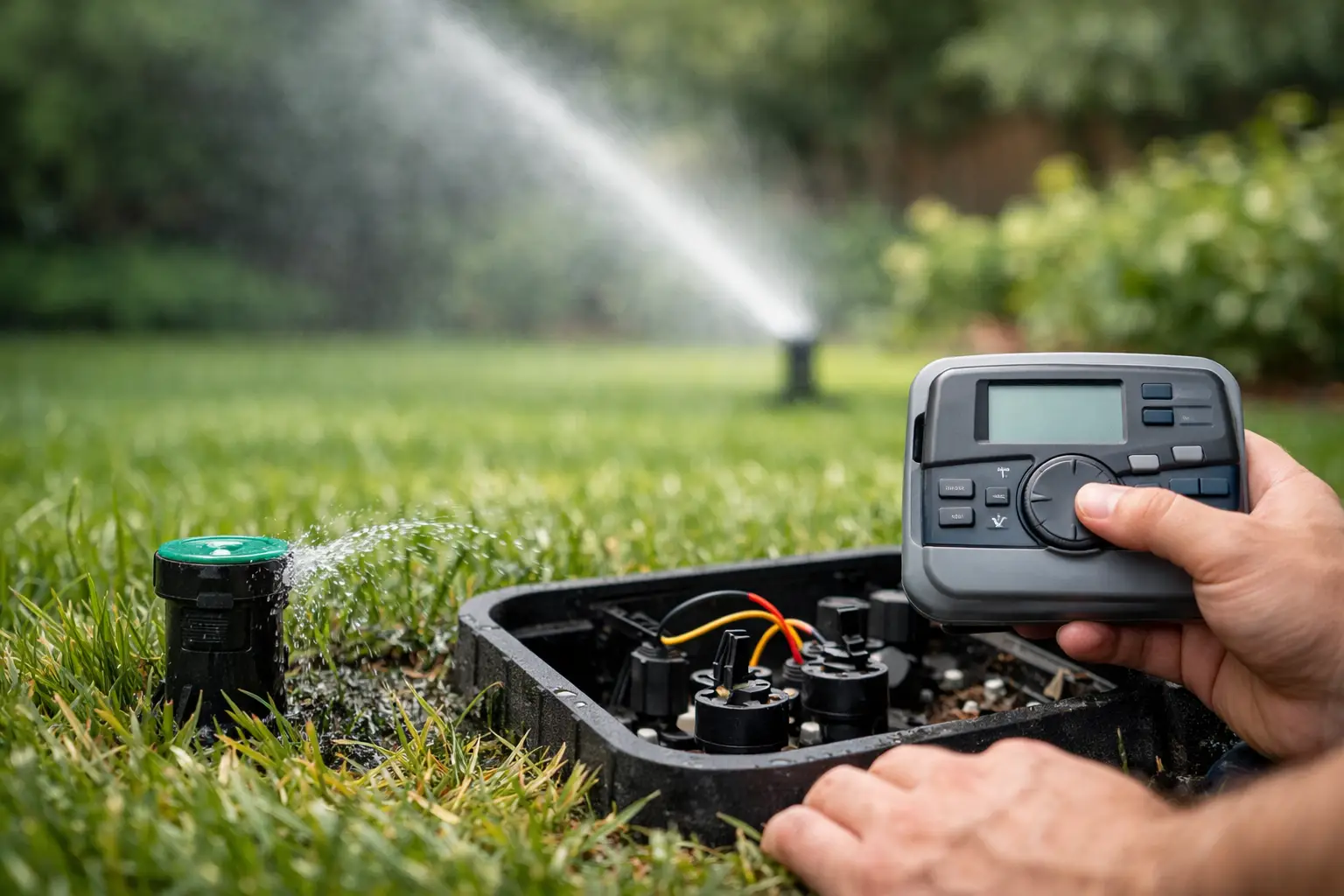
When a sprinkler system won't turn on, the problem usually shows up at the worst possible time - right as the lawn starts drying out, a garden bed begins to stress, or a scheduled watering cycle quietly fails overnight. In most cases, the issue comes down to power, programming, water supply, or a failed component in the field. The key is knowing which category you are dealing with before a small interruption turns into landscape damage or wasted time.
What it usually means when a sprinkler system won't turn on
A system that does nothing at all is different from a system that runs poorly. If no zones activate, the controller is blank, or the valves never respond, the failure point is often at the controller, power source, rain sensor, master valve, or main shutoff. If the controller appears normal but no water reaches the heads, the issue may be hydraulic rather than electrical.
That distinction matters. A dead controller and a closed irrigation shutoff can look similar from a distance, but they require very different fixes. For homeowners, the most efficient approach is to start with the simplest checks and then move toward components that typically need professional testing.
Start with the controller
The controller is the first place to look because it governs the entire system. If the screen is blank, check whether the unit has power. A tripped outlet, loose transformer, or interrupted GFCI connection can shut the system down completely. After power is restored, some controllers lose their programmed schedule, current time, or date, which can make it seem like the system failed when it is really no longer set to run.
If the display is active, review the mode setting. Controllers are often left in off, rain hold, or manual stop after service or seasonal shutdown. It is also worth checking whether the start times or watering days were accidentally changed. More than a few service calls begin with a controller that is healthy but no longer programmed to irrigate.
A smart controller can add another layer. Weather-based settings, app changes, and seasonal adjustments improve efficiency, but they can also pause watering if the settings are too restrictive or if communication has been interrupted. In that situation, the system is not necessarily broken, but it is not operating as intended.
Check for sensor-related shutdowns
Rain and freeze sensors are designed to stop irrigation when conditions call for it. That is useful, but a faulty sensor or damaged sensor wire can prevent every zone from running. If your controller indicates a sensor alert or bypass mode, that is a clue.
In Colorado, spring and fall weather can create odd sensor behavior. A freeze event, sudden moisture, or temperature swing may leave the system paused when you expect it to run. If bypassing the sensor temporarily restores operation, the sensor circuit likely needs attention rather than the whole system.
Confirm the water is actually available
A sprinkler controller can be powered and properly scheduled, but the system still will not run if water is not reaching the irrigation line. This is especially common at the beginning of the season after winterization, repairs, or landscape work.
Start by checking the main irrigation shutoff. If it is closed, partially closed, or was never reopened after service, no zone will operate correctly. Backflow assemblies should also be inspected visually. Closed test cocks or isolation valves can stop the system entirely.
This is one of the most common spring issues in Parker, Castle Rock, and nearby areas, where systems are shut down for winter and then brought back online when temperatures stabilize. A system that worked perfectly last fall may simply not have been fully reopened during startup.
Watch for a master valve issue
Some irrigation systems use a master valve that opens only when a zone is called to run. If that valve fails, every station may stay dry even though the controller appears normal. To the homeowner, it can look like a total system failure.
Master valve problems often require electrical testing or valve inspection at the manifold. That is where a focused irrigation diagnosis is more useful than guesswork. Replacing the wrong part wastes time and does nothing for the lawn.
If one zone works but others do not, the problem is more specific
Not every "sprinkler system won't turn on" complaint means the whole system is down. Sometimes one zone runs while another stays off, hums, or partially activates. That usually points to a field component rather than a controller-wide issue.
A stuck or failed valve is a common cause. Debris in the valve, a damaged solenoid, or wiring failure between the controller and valve can prevent that zone from opening. In some cases, the valve opens but flow is too restricted to pop up the heads properly.
Broken wire is another frequent culprit, especially in older systems or landscapes that have had recent digging, edging, or other ground disturbance. The controller may send the command, but the signal never reaches the valve.
Solenoid and valve failures are easy to misread
When a valve solenoid fails, the symptoms can mimic other problems. You may hear a faint click at the controller but get no irrigation in the yard. Or the valve may activate inconsistently, which leads homeowners to suspect scheduling when the real issue is mechanical or electrical failure at the valve.
This is one reason irrigation systems benefit from specialized service. Sprinkler diagnostics are rarely about one obvious broken part. Often, the system needs to be tested zone by zone to confirm whether the failure is in the controller output, the wire path, the solenoid, or the valve body itself.
Seasonal conditions can cause startup failures
In climates with winter shutdowns, early-season startup is a common moment for hidden issues to surface. A controller battery may have failed during the off-season. A freeze may have affected exposed components. Valves that sat idle for months may not open cleanly on the first cycle.
That does not always mean major repair is needed. Sometimes a startup adjustment, reprogramming, or targeted valve service brings the system back to normal. Other times, a small crack, wiring issue, or sensor fault only becomes obvious once the system is pressurized and asked to run again.
Homeowners who want predictable watering usually benefit from treating startup as a system check, not just a date on the calendar. Reliable irrigation comes from confirming that controls, valves, pressure, and coverage are all working together.
When the controller works but nothing happens
If the controller appears normal, the schedule is correct, and the water supply is open, but nothing happens when you manually start a zone, the issue is likely beyond basic homeowner troubleshooting. The most common causes at that point are failed field wiring, a faulty common wire, a bad solenoid, a failed master valve, or controller output problems.
Electrical faults can be difficult to isolate without proper testing. A damaged common wire, for example, can disable multiple stations at once and create confusing symptoms. The system may look partially alive while never actually delivering water.
This is where professional irrigation service adds value quickly. Instead of replacing parts one by one, a technician can identify where the command is stopping and correct the actual failure point.
Signs it is time to schedule sprinkler repair
Some problems are reasonable to check yourself, such as a shutoff valve, a blank controller, or an obvious programming issue. Beyond that, the more efficient path is usually service. That is especially true if the landscape depends on reliable watering through warm, dry stretches.
It makes sense to schedule repair if the controller has power but no zones respond, if only certain zones fail repeatedly, if valves hum without opening, or if the system stopped working after winter shutdown or startup. The same applies if you suspect a wiring fault, sensor problem, or backflow-related interruption.
A well-maintained irrigation system should not be unpredictable. When it stops responding, the goal is not just getting it back on for one cycle. The goal is restoring dependable, efficient operation so the system waters when it should and stays off when it should.
For homeowners who value landscape health and water efficiency, that level of reliability matters. If your sprinkler system won't turn on, a focused diagnosis usually resolves the problem faster than repeated resets and trial-and-error fixes. A healthy lawn starts with a system you can trust to respond when the season calls for it.